About Geography
Geography provides people and society with scientific and professional knowledge and understanding about the earth and the world. Moreover, geography delivers tools and instruments to use this knowledge in practice. Central in geographical enquiry is the relation between people, society and their geospatial environment. From the daily local and regional environment in which we live, move and travel, via higher scale regional and national environments, up to the global environment: the earth and the world as the resource base for and the home of human being.
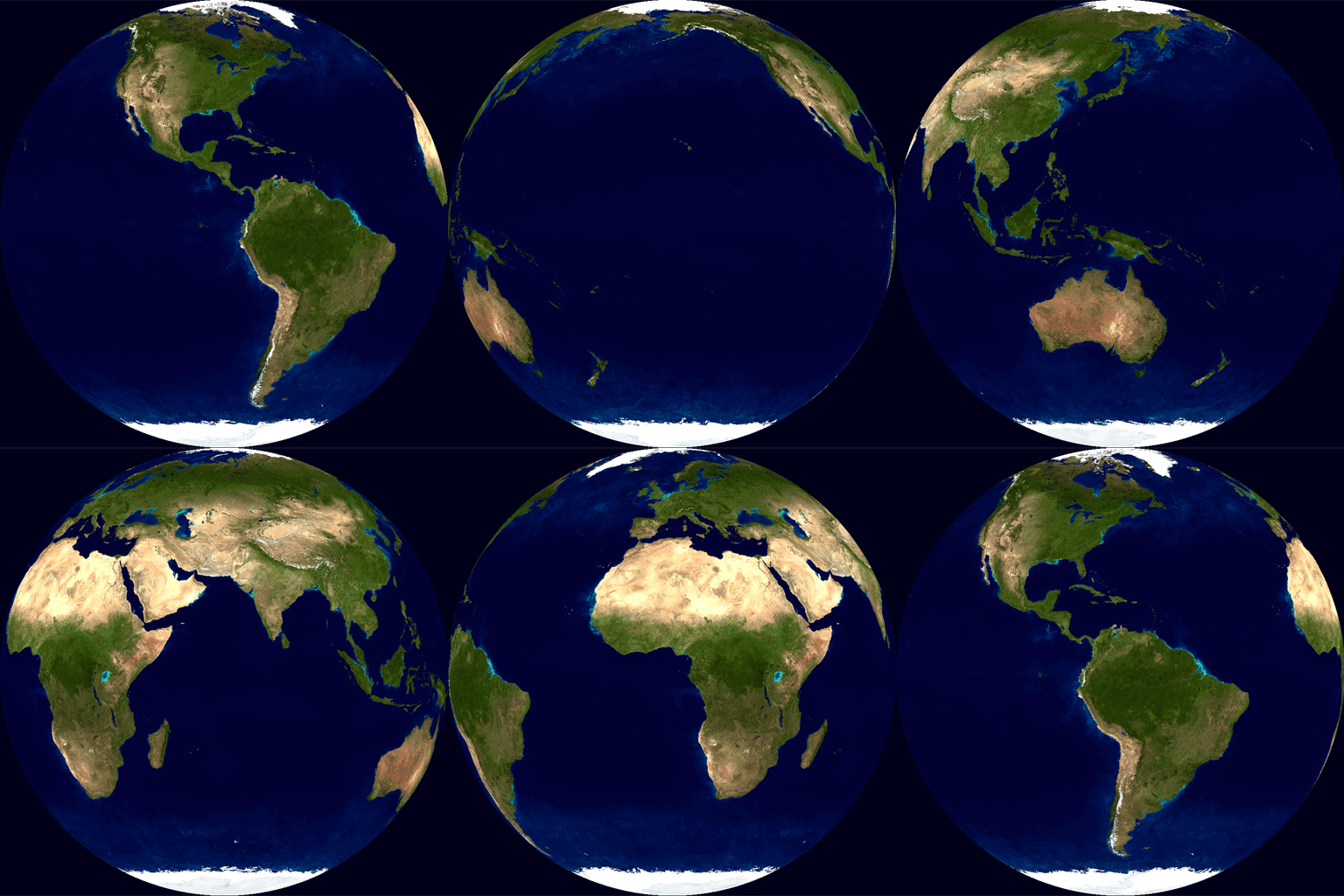
Good introductions into what geography is can be found on the websites of the Royal Geographical Society (http://www.rgs.org/GeographyToday/What+is+Geography.htm ) and the International Geographical Union (http://www.igu-online.org/site/?page_id=657 ). Also, take a look at Wikipedia (http://en.wikipedia.org/wiki/Geography) or the Geography page of Wikipedia in your own language.
Geography is a broad subject that combines and integrates natural, social and technical bodies of knowledge. The core of Geography is the study of the nature, identity and diversity of locations, places and regions on or near the surface of the earth. Also, the interactions and movements over geospace are analysed, as are the relations between human phenomena (social space) and physical phenomena (natural and built space).
Geographers study the current situation and dynamics over time, both retrospective and prospective. The specialisations Regional Geography, Landscape Geography and Environmental Geography form a major backbone of the Geography discipline. In these domains, Physical Geography, studying processes and patterns in the natural environment, and Human Geography, studying the man-made social and built environment, meet. Theoretical frameworks based on the concepts of space, time and scale support these holistic approaches.
But geographers also want and need to understand, and develop conceptual, interpretive, explanatory and evaluative methodology and theory about geospatial behaviour, patterns, processes, relations, movements and dynamics, both of natural phenomena and human activities/phenomena. Moreover, critical assessments of the state of development of our environment are undertaken. These efforts have resulted in a whole range of thematic geographical specialisations and approaches. In many of these sub-disciplines geographers often incorporate knowledge and methods from adjacent or overlapping (sub-)disciplines and work together with scholars of these disciplines. In these specialisations the multi/interdisciplinary character of geography is most pronounced. Well established examples are: Geomorphology, Geohydrology, Biogeography, Urban Geography, Economic Geography, Cultural Geography and Political Geography. Examples of less common or very recent specialisations are: Military Geography, Marxist Geography, Geography of the Bible, Evolutionary Geography, Web Geography and Financial Geography. Especially within Economic and Transportation Geography, studying spatial efficiency or profitability are common research aims.
The search for and promotion of sustainable relations between individuals, groups and society at large and their natural, built and social environments at different space/time scales is a main task of geography and geographers. Within Human Geography, the spatial aspects social justice is another normative object of study.
Geographical technologies (Technical Geography, GeoICT or Geomatics) have been developed over the centuries to support geographical inquiry and the dissemination and application of geographical knowledge. Cartography (maps, globes, digital mapping, etc.), spatial statistics and modelling, navigation systems (GPS), location based (web)services (LBS) and geographical information systems (GIS) are widely used examples, in science as well as in practice. They are jointly used in Human Geography and Physical Geography. (Geo)graphical computer and information network applications have developed particularly fast over the last decades, Also in this area, cooperation with adjacent fields like cartography, geodesy, surveying, remote sensing/earth observation and computer science is the rule. These technologies together form a sizable Geo-Information Science and Technology community and business sector.
In addition to the integrated spatial perspective, the interdisciplinary oriented thematic specialisations and the geospatial technologies, empirical research, fieldwork methodology and producing knowledge and tools for applications in practice are characteristics of much of the work geographers do. Planning, decision-making and management of urban and rural areas, regions, physical infrastructure, natural resources and environmental quality are fields where many geographers work. But also in public services, housing, real estate, transportation and logistics, travel and tourism, the media, international relations, international business and in international development geographers contribute.
Geography has a long tradition in education. It has, often starting in the 19th century, been one of the core subjects in general education in primary and secondary schools. Geographical knowledge and skills are considered essential for personal development, local and world orientation, supporting good citizenship and promoting sustainable development. Geographical education has evolved from topography and map reading into learning children to understand their own living environment as well as understanding the earth and the world as the resource base for and the home of human being for which a sustainable development course is needed. This spatial/geographical awareness and literacy is essential in personal and professional life. At upper level secondary education, more specialized geography courses are often an elective subject that prepares for academic bachelors programmes in geography and related disciplines and for professional education in fields like tourism, transportation and spatial and environmental planning and management. Many universities offer general geography programmes at bachelor, and specialised geography programmes at master and PhD level. Geographers also contribute to broad, multidisciplinary programmes like Liberal Arts, and Sciences, Regional/Area Studies, Urban Studies, Planning Studies, Environmental Studies and Development Studies.